




Cluster’s final dance: the end of a pioneering ESA mission
On 1st September 2026, Tango, the last of ESA’s four Cluster satellites, burned up in Earth’s atmosphere over the South Pacific Ocean. Just one day earlier, Samba had met the same fate. Their spectacular re-entries brought the final chapter of Cluster to an end, 26 years after the four spacecraft were launched to explore Earth’s magnetic environment. But even during their destruction, the Cluster satellites were still contributing to science.
A final dance over the Pacific
On 31 August 2026 at 23:39:38 CEST, Samba entered Earth’s atmosphere over a remote part of the South Pacific. Almost exactly 24 hours later, on 1st September, at 23:30:31 CEST, Tango followed. Tango was the last of the four Cluster spacecraft and its disappearance marked the completion of an unusual two-year re-entry campaign. The other two members of the quartet had already returned to Earth: Salsa on 8 September 2024 and Rumba on 22 October 2025.
Cluster's scientific operations had already ended on 30 September 2024. But instead of abandoning the remaining spacecraft and waiting for them to fall back to Earth, ESA transformed their final years into a new experiment: using four almost identical satellites to better understand what happens when a spacecraft re-enters the atmosphere.
A new type of targeted re-entry
The four Cluster spacecraft were launched in 2000, long before today's strict requirements concerning the disposal of satellites and the mitigation of space debris. Their highly elliptical orbits also made conventional controlled re-entries impossible.
ESA therefore developed a different approach: the targeted re-entry. Several months before each re-entry, operators slightly modified the spacecraft's orbit. The satellite was then left to evolve naturally until gravitational perturbations from the Sun and Moon brought its lowest orbital point deep enough into the atmosphere for the spacecraft to burn up. The manoeuvres were calculated so that this would happen above a remote area of the South Pacific, far from populated regions. The spacecraft were therefore not actively manoeuvred during the re-entry itself, although their trajectories continued to be closely monitored until shortly before atmospheric entry.. Nevertheless, their trajectory could be predicted with remarkable precision. For Samba, the final prediction of the re-entry time proved accurate to the second.
With four identical spacecraft re-entering at different times, speeds, angles and atmospheric conditions, Cluster provided something rarely available to re-entry scientists: the possibility of repeating essentially the same experiment several times but under different conditions.
Watching satellites being destroyed
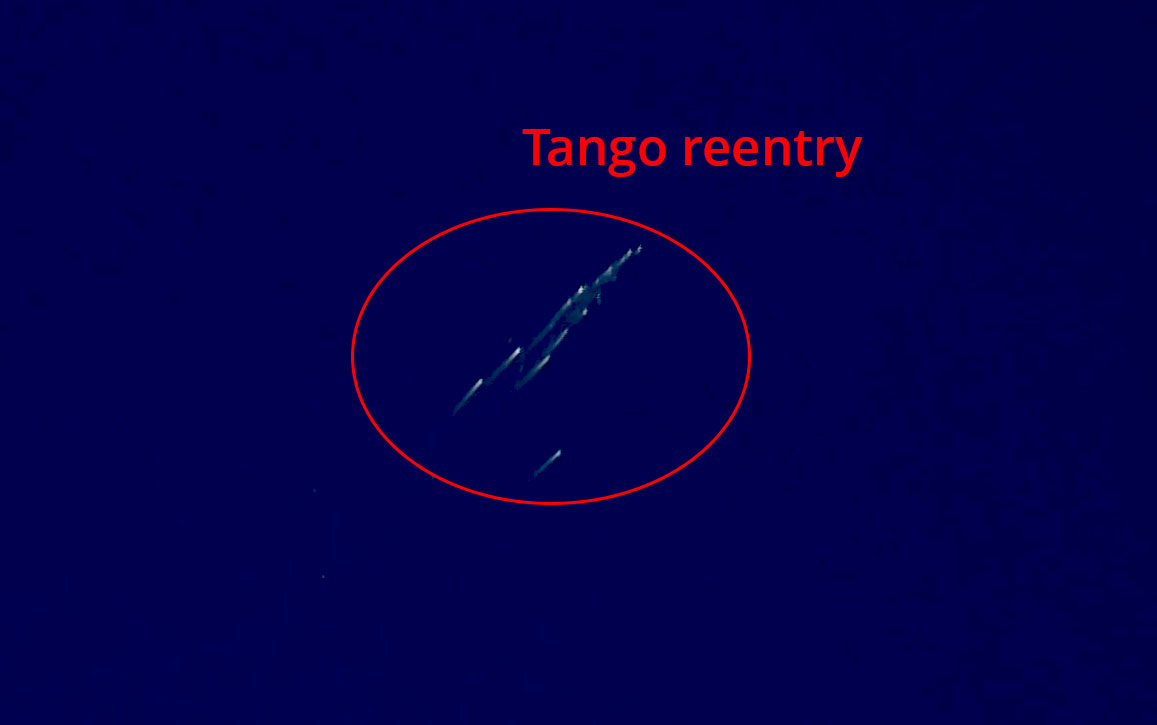
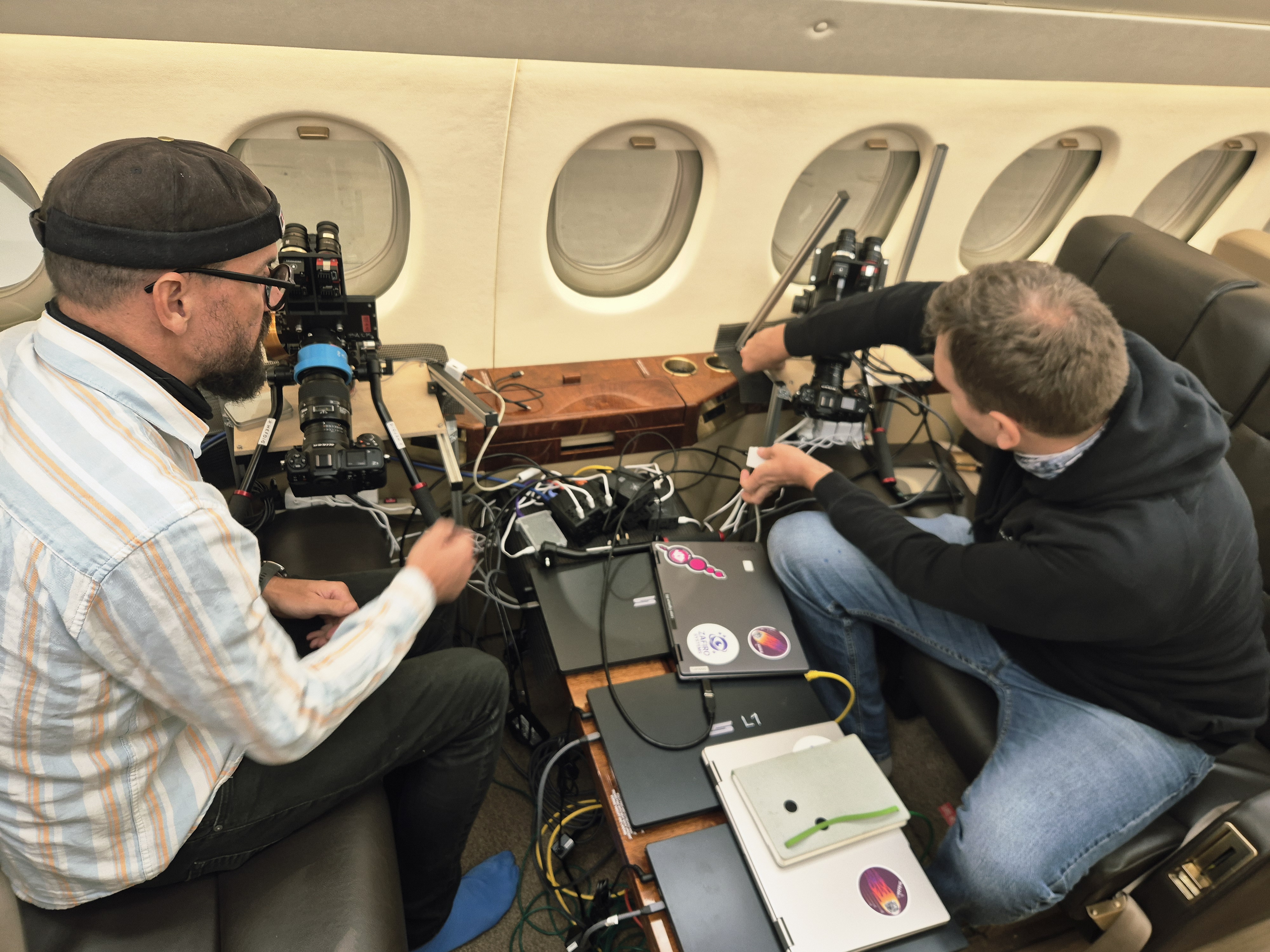
Accurately predicting where the spacecraft would re-enter also made it possible to do something even more unusual: watch the destruction from nearby. For the final re-entries of Samba and Tango, the ROSIE airborne observation team flew from Tonga aboard an aircraft equipped with cameras and scientific instruments. The flight path was calculated to place the aircraft in the right position as each spacecraft crossed the atmosphere above the Pacific.
The campaign was highly successful. 29 of the 30 instruments aboard the aircraft recorded Samba re-entry for about 50 seconds as it broke apart across the sky. During Tango's re-entry, even the aircraft's pilot contributed to the observation by banking the plane to keep the burning spacecraft in view for a few additional seconds.
The images of Samba show not simply one bright object like it was the case for the first re-entry (Salsa, September 2024) but dozens of individual fragments streaking through the atmosphere. Tracking cameras provided information on the position and fragmentation of the spacecraft, while other instruments were designed to detect specific materials and help determine which spacecraft components were being observed as they disintegrated.
Why study a satellite burning up?
Despite the large number of spacecraft and rocket stages that have returned to Earth since the beginning of the space age, detailed observations of the actual breakup process remain surprisingly rare. A spacecraft travelling through the upper atmosphere experiences extreme heating. Different components melt, vaporise or fragment at different altitudes, and some materials may survive considerably longer than others. Understanding precisely when a spacecraft breaks apart, how its fragments behave and which materials survive is therefore essential for improving re-entry models.
Such models help predict more accurately where surviving fragments could reach the ground. They are also increasingly important for developing “design-for-demise” spacecraft whose components are designed to burn up as completely as possible during re-entry. At the same time, scientists want to better understand which materials are released into the upper atmosphere as a growing number of satellites reach the end of their lives.
The Cluster campaign therefore turned the disposal of an old scientific mission into a test case for safer and more sustainable spaceflight.
A final goodbye to Cluster
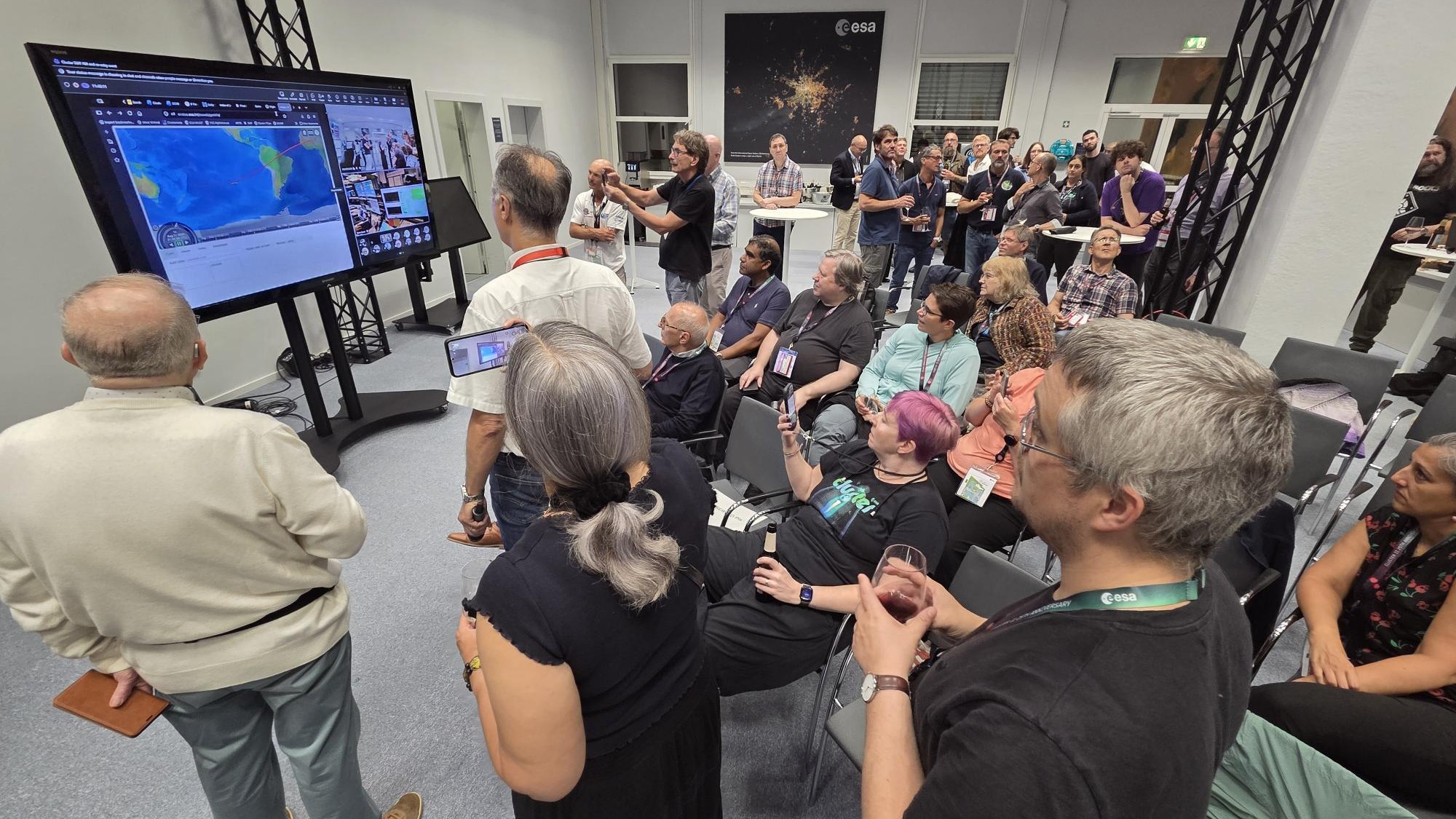
Tango's re-entry also had a strong symbolic dimension. Shortly before the spacecraft disappeared, members of the Cluster flight-control, mission and re-entry teams at ESA's European Space Operations Centre sent their final commands to the satellite. The last telemetry signal was lost about fifteen minutes before re-entry. It was the final physical goodbye to a mission that had spent more than two decades studying Earth's magnetosphere.
BIRA-IASB had been involved in Cluster since its development. Its scientists contributed to the WHISPER instrument carried aboard all four spacecraft and were strongly involved in the analysis of Cluster data. Over the mission, BIRA-IASB researchers used Cluster observations to study many regions and processes within Earth's magnetosphere and contributed to the development of methods for exploiting simultaneous measurements from the four spacecraft. More recently, BIRA-IASB participated in the Geospace Region and Magnetospheric Boundary (GRMB) project, which classified the regions and boundaries encountered by the Cluster spacecraft throughout the mission, helping to make its exceptionally long data archive easier to exploit scientifically.
The spacecraft are now gone. Cluster's data, however, remain and will continue to be used to investigate Earth's space environment long after the quartet's final dance.
More details available at :
News image 1
News image legend 1
Credit: ESA/ROSIE/University of Stuttgart (HEFDiG)
News image 2
News image legend 2
Credit: ESA/Astros Solutions/ROSIE
News image 3
News image legend 3
Credit: ESA